The Dialectical Behavior Therapy Skills Workbook for Anxiety by Alexander Chapman
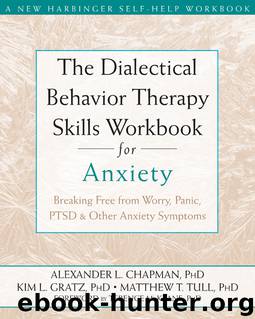
Author:Alexander Chapman [Alexander L. Chapman, Kim L. Gratz, Matthew T. Tull]
Language: eng
Format: epub, mobi
ISBN: 9781608826148
Publisher: New Harbinger Publications
Published: 2014-04-16T04:00:00+00:00
The following exercise in urge surfing is adapted from our book Freedom from Self-Harm: Overcoming Self-Injury with Skills from DBT and Other Treatments (Gratz and Chapman 2009).
Exercise 5.5 Urge Surfing: A Mindfulness Skill to Cope with Urges
Find a quiet place where you will be relatively free of distractions and won’t be bothered by anyone. Sit in a comfortable position. Write down how strong your urge is on a scale from 0 (no urge at all) to 10 (the strongest urge you have ever had). Then, write down how much you feel that you can handle your urge, using a scale from 0 (can’t take it for one more second) to 10 (could handle it for ten hours straight if you had to). Imagine that you are standing on a surfboard on the ocean in a warm, tropical place. You can see the white, sandy shore in front of you, there is a slight breeze, and you can smell the salt of the ocean. There are a few fluffy, white clouds overhead, and the sun feels warm on your back. Really transport your mind to this scene.
Now, imagine that your action urge is the wave that you are about to catch. As your urge rises and becomes stronger, the wave gets higher, but you keep right on top of it. Imagine that you’re an excellent surfer who can handle any wave that comes your way. As the urge gets stronger and stronger, the wave gets higher and higher until it crests. Imagine that you are riding the wave to shore. As you watch and surf the wave, notice what happens to it. Notice if it gets higher and stronger, or if it starts becoming lower and weaker. When it gets weaker, imagine that you are sliding into shore on your surfboard. When it starts to build again, imagine that you are back out there on the wave, just riding it. Keep doing this for about ten minutes, or until you feel that you have a handle on the urge and will not act on it. At the end, write down how strong your urge is on a scale from 0 to 10 and how much you feel that you can handle your urge on a scale from 0 to 10.
Use the following exercise to come up with as many short-term and long-term consequences of impulsive behaviors as you can. Make sure you fill in each of the four boxes in the table and include both positive and negative consequences. There are three important steps to remember about this skill: (1) write down only the important consequences; (2) memorize your list of consequences so that you can use it next time you need it without much thought or effort, or make a copy of this list and carry it with you; and (3) pay a lot of attention to the negative consequences of the problem behavior. Use this strategy to get yourself motivated to go down a different path when you’re stressed out.
Download
The Dialectical Behavior Therapy Skills Workbook for Anxiety by Alexander Chapman.mobi
This site does not store any files on its server. We only index and link to content provided by other sites. Please contact the content providers to delete copyright contents if any and email us, we'll remove relevant links or contents immediately.
Unwinding Anxiety by Judson Brewer(73189)
The Art of Coaching by Elena Aguilar(53414)
The Fast Metabolism Diet Cookbook by Haylie Pomroy(21181)
Rewire Your Anxious Brain by Catherine M. Pittman(18709)
Healthy Aging For Dummies by Brent Agin & Sharon Perkins RN(17069)
Talking to Strangers by Malcolm Gladwell(13438)
The Art of Thinking Clearly by Rolf Dobelli(10597)
Mindhunter: Inside the FBI's Elite Serial Crime Unit by John E. Douglas & Mark Olshaker(9418)
Crazy Rich Asians by Kevin Kwan(9345)
The Compound Effect by Darren Hardy(9052)
Tools of Titans by Timothy Ferriss(8489)
Periodization Training for Sports by Tudor Bompa(8329)
Becoming Supernatural by Dr. Joe Dispenza(8277)
Wonder by R. J. Palacio(8165)
Bodyweight Strength Training by Jay Cardiello(7968)
Crystal Healing for Women by Mariah K. Lyons(7965)
Change Your Questions, Change Your Life by Marilee Adams(7847)
Nudge - Improving Decisions about Health, Wealth, and Happiness by Thaler Sunstein(7758)
Therapeutic Modalities for Musculoskeletal Injuries, 4E by Craig R. Denegar & Ethan Saliba & Susan Saliba(7744)
